Posts
Posts


When I think about the relationship between city and architecture, I think of democracy. Architecture can be the representation of a community. We can grasp this concept when there is an absence. When the Buddhas in Afghanistan or the Twin Towers in New York were destroyed, or the Golden Dome of Samarra in Iraq disappeared, or the synagogue in Dresden was destroyed by Nazis, there was a feeling of absence, of lack, of vacuum. Such events, after which architecture no longer exists, help us better understand its importance. Even when they are ugly, don't function or are aesthetically horrible, buildings are the representation of society.
Architecture can - or rather must - have an effect on society. Because what we architects do is try to build a set in which people are the actors. Architecture cannot be independent of people, because if we imagine a city without people, or people without architecture, there is an evident absence. Human beings are obliged to live together with their architecture. s0 we design a set in which the actors perform, and if this set does not allow their entrances and exits, or the culmination of the action, everything collapses.
If you say to an inhabitant of Paris's banlieue that the buildings should be demolished because they are ugly, he will respond that, yes, they are ugly, but he doesn't want another typology. And you think: 'How come, they're ugly, you live badly, you've burnt the stairs, the lifts don't work, the landings are a disaster, why do you want them?' And he replies: 'Because we were born here'. He has performed his human comedy in the set that was offered him, even if in the worst possible place. There is a challenge of sensitivity here, because you know you have to destroy this set so as not to perpetuate these places of desperation, but at the same time you have to find a way to enable the transition, There is no building that can be annulled in an instant.
When I do a project I speak of 'geography' and not of landscape. There are three components in geography, but we architects usually tend to ignore at least two of them. The first component is the landscape, then there is the economy and the third is the human being. These three things are essential for proceeding toward a better understanding of what we are doing. So geography has taken on a fundamental importance. I started talking about geography 20-odd years ago without knowing what the outcomes would be. The architect is never a theorist, but rather someone who has an idea, forgets it the next day and does something else, I used 'geography' because it was more useful to me, in that I substituted it for 'morphology'. Rather than making a territorial, topological, topographical analysis of places, I used a concept, geography, which yielded greater complexity.
I also think it is necessary to talk of 'context'. There are extreme positions, the mythomaniacs of context or those who hate it. I'm not for 'fuck the context' or 'context is best'. I'm for the idea that context exists.
Another word I use a lot along with geography is 'horizon': you move the horizon, raise it, lower it, then turn it around. It's like cinema, Rossellini used to say: 'I'm never behind the camera, only in front'; he never looked through the viewfinder. Technique is useful until you understand it, after that you no longer use it.
Bruno Zevi told me that it was not enough to be a great architect. There is something more: to be a good architect, with interest in the greater complexity of society. I think the architect ought to resume the role of connecting those parts of society that are no longer together. We ought not to dream up visions of a future world [though no one forbids it], but rather begin to revisit the initial problem: how can the architect help many different people live together without killing one another, without insulting one another, with respect and resources for all? Of course one can't resolve everything alone, but we have to start becoming part of that process. The architect should be like Brunelleschi, who was greeted when he walked around Florence; like Masaccio, like Tintoretto, who were part of a community. As a profession, we have to go back to being part of a community.
Massimiliano Fuksas was speaking with Richard Burdett
Article taken from Cities, Architecture and Society: 10th International Architecture Exhibition - Venice Biennale 2006, Volume 1
Showing posts with label sense of place. Show all posts
Showing posts with label sense of place. Show all posts

The way we live
Excerpts and scanned pages taken from The Way We Live by Cliff, Stafford & Chabaneix, Gilles de. [2003]
THE MARKET-PLACE
The fresh food market is the first step in the distribution of foodstuffs from kitchen garden, from farm and plantation, from field and orchard, from river and sea. Leaving aside the supply chains to supermarket and processed food plant, the market appeals to that deep human wish to acquire raw food in as fresh a condition as possible. And nowhere is this more true than in the fish and seafood stalls the world over.
Most markets impress by their colours and the simplicity of their presentation. In fish markets, especially those on the quayside illuminated by the intense light off the sea, the brilliance of the hues and the boldness of pattern make for delicious visual preliminaries to the pleasures of cooking and consumption. Pinks and reds combine with silvers to gleam and glow with phosphorescence in the fresh rays of a coastal dawn - here, in Tangier. And all the colours of the ocean rainbow hang in a quayside fishmonger's in Valparaiso, Chile.
A market is a place of abundance and of richness of display: colours bright and fresh, whether arranged singly or in pyramids. Thank goodness, what is on sale varies from place to place, country to country, but we recognize the authentic market the world over by its evocation of 'plenty', by the display of tomatoes, peppers, courgettes and aubergines in any Mediterranean town, or by the towering arrangements of guavas, papayas, pineapples and breadfruit in the tropics. The breadfruit - proudly displayed by a Balinese chef (pic can be found from the book 'The Way We Live') - is native to the Pacific Islands. In 1793 it was introduced to Jamaica by Captain Bligh of Bounty fame in the belief that it could become the staple food of the slave population. The scheme was not a great success, but Jamaica does remain a major producer.
The imagery of the market-stall, whether a boat in Bangkok or a food counter in Burundi, is among the most potent in our appreciation of the good things of life and as close as many people get to the wider natural world. The imagery is rich in colour, texture, form and pattern, brought to life by the presence of people, often producers, in the processes of exchange. This is a world of buyers and sellers meeting with immediacy impossible in more rigidly formal environments (pic can be found from the book 'The Way We Live'). Sometimes the two parties come together in unplanned, spontaneous ways; this roadside market in Burundi developed as an almost impromptu happening (pic can be found from the book 'The Way We Live'). One man's meagre display is another's cornucopia; but however rich or spare the presentation, there is always the prospect - warm and reassuring - of acquisition and eventual consumption.
Whether a neighbourhood market in Paris, Rome or London or a village or country-town market in Morocco or Mauritius, the gathering together of people and produce is a real point of focus for a community, and any visitor. It is an opportunity for the exchange of views and gossip; and the feel-good fallout from the presence of so many good things is incalculable (pic can be found from the book 'The Way We Live'). Elizabeth David, surely the greatest English writer on food matters, found a unique joy in the sheer volume and variety on display in a good market: tomatoes, courgettes, peppers, melons, asparagus, strawberries, redcurrants, cherries, apricots, peaches, pears and plums. Her remarks were largely confined to descriptions of the markets of Provence and Italy, but her enthusiasm powerfully evoked the feelings aroused by food markets throughout the world.


THE MARKET-PLACE
The fresh food market is the first step in the distribution of foodstuffs from kitchen garden, from farm and plantation, from field and orchard, from river and sea. Leaving aside the supply chains to supermarket and processed food plant, the market appeals to that deep human wish to acquire raw food in as fresh a condition as possible. And nowhere is this more true than in the fish and seafood stalls the world over.
Most markets impress by their colours and the simplicity of their presentation. In fish markets, especially those on the quayside illuminated by the intense light off the sea, the brilliance of the hues and the boldness of pattern make for delicious visual preliminaries to the pleasures of cooking and consumption. Pinks and reds combine with silvers to gleam and glow with phosphorescence in the fresh rays of a coastal dawn - here, in Tangier. And all the colours of the ocean rainbow hang in a quayside fishmonger's in Valparaiso, Chile.
A market is a place of abundance and of richness of display: colours bright and fresh, whether arranged singly or in pyramids. Thank goodness, what is on sale varies from place to place, country to country, but we recognize the authentic market the world over by its evocation of 'plenty', by the display of tomatoes, peppers, courgettes and aubergines in any Mediterranean town, or by the towering arrangements of guavas, papayas, pineapples and breadfruit in the tropics. The breadfruit - proudly displayed by a Balinese chef (pic can be found from the book 'The Way We Live') - is native to the Pacific Islands. In 1793 it was introduced to Jamaica by Captain Bligh of Bounty fame in the belief that it could become the staple food of the slave population. The scheme was not a great success, but Jamaica does remain a major producer.
The imagery of the market-stall, whether a boat in Bangkok or a food counter in Burundi, is among the most potent in our appreciation of the good things of life and as close as many people get to the wider natural world. The imagery is rich in colour, texture, form and pattern, brought to life by the presence of people, often producers, in the processes of exchange. This is a world of buyers and sellers meeting with immediacy impossible in more rigidly formal environments (pic can be found from the book 'The Way We Live'). Sometimes the two parties come together in unplanned, spontaneous ways; this roadside market in Burundi developed as an almost impromptu happening (pic can be found from the book 'The Way We Live'). One man's meagre display is another's cornucopia; but however rich or spare the presentation, there is always the prospect - warm and reassuring - of acquisition and eventual consumption.
Whether a neighbourhood market in Paris, Rome or London or a village or country-town market in Morocco or Mauritius, the gathering together of people and produce is a real point of focus for a community, and any visitor. It is an opportunity for the exchange of views and gossip; and the feel-good fallout from the presence of so many good things is incalculable (pic can be found from the book 'The Way We Live'). Elizabeth David, surely the greatest English writer on food matters, found a unique joy in the sheer volume and variety on display in a good market: tomatoes, courgettes, peppers, melons, asparagus, strawberries, redcurrants, cherries, apricots, peaches, pears and plums. Her remarks were largely confined to descriptions of the markets of Provence and Italy, but her enthusiasm powerfully evoked the feelings aroused by food markets throughout the world.


Kuching at a glance

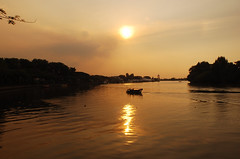
Kuching Waterfront, Sunset
Originally uploaded by sayap+dewa

Kuching Waterfront
Originally uploaded by MarkLeo

Fort Margherita
Originally uploaded by Journey of A Thousand Miles

Astana
Originally uploaded by Ahock

D2H6685_20060208_1759_33
Originally uploaded by Ahock

Masjid Bahagian Kuching
Originally uploaded by bingregory

Part of Kuching - The triangle
Originally uploaded by framptop

Kuching Post Office
Originally uploaded by spOt_ON

part ii , colonial kuching
Originally uploaded by ★ mewot ★

Sarawak Textile Museum II
Originally uploaded by Tok Wae

Kuching - The Cat City
Originally uploaded by onggon ~ im on holiday

Museum Kuching
Originally uploaded by gLaSS 'n' MeTaL

Kuching
Originally uploaded by Yokels

India Street
Originally uploaded by MarkLeo
Discarding the old, in the new supermarkets - Asia
The increase popularity of shopping malls in Asia does help to put its most important tenant - supermarket in winning position over traditional farmers markets. For Kuching it is a double blow as after the closure of Ceko market the city has no markets in the city centre (except the Satok sunday wet market 1km away) hence giving golden opportunities for supermarkets to extend their radius to dominate and continue threaten the remaining old shops at the old quarters of Chinatown and Indian street.
The new Plaza Merdeka to be built in the heart of the old quarters presumably will has a supermarket will take over the original retail pattern left from the Ceko Market nearby (about 150m away) and will pose significant threat to the remaining shop fronts foods and produces and other retail sectors on that area.
Will the people go to the shopping mall to get all they need under one roof ignoring other traditional retails around the area?
The following excerpt taken from article published by Food and Agriculture Organization of the United Nations:
The move to supermarkets in Asia is driven by a number of factors - including automobiles...
Exit interviews were used to summarize factors attracting consumers to six supermarkets and three wet markets in a representative city. Using the history of the marketplace as the foundation for analysis, the strengths and weaknesses of the two retail formats are introduced and are compared to the consumer response data. Findings indicate that the decline of Taiwan's traditional markets will probably continue until all are replaced by new retail formats. Currently, the traditional market is in the weakest of all the retail positions since it supplies the needs of a shrinking population of older consumers with preferences and shopping behaviors unlike those of younger, nontraditional consumers. Supermarket expansion is slowing because new hypermarkets, convenience stores, and warehouse stores are competing to satisfy the needs of the younger, more mobile target population. Overall, store formats that provide lower prices, sales promotions, a good environment, good product quality, and good service have the greatest opportunity to build consumer loyalty and increase market share."
Related Posts:
1) Benefits of markets
2) The market that defines the city [Melbourne]
3) Slow Living & Old Market
The new Plaza Merdeka to be built in the heart of the old quarters presumably will has a supermarket will take over the original retail pattern left from the Ceko Market nearby (about 150m away) and will pose significant threat to the remaining shop fronts foods and produces and other retail sectors on that area.
Will the people go to the shopping mall to get all they need under one roof ignoring other traditional retails around the area?
The following excerpt taken from article published by Food and Agriculture Organization of the United Nations:
The move to supermarkets in Asia is driven by a number of factors - including automobiles...
- Income growth has increased ownership of refrigerators, which has spurred a shift from daily to weekly shopping, and of cars, which permit large volume shopping at distant locations
- Changing consumer preferences led by women's entry into the workforce. "Working women" prefer one-stop, fast, convenient, and value-for-money shopping
- Changing eating habits - with more women working outside the home and families travelling further to work, there is increasing demand for processed food
- Development of infrastructure, e.g. highways and transport, has favoured the development of supermarket chains
- Low retail margins and fierce competition has created a "buyer's market" in which consumers enjoy low-cost services and quality - and happily switch between retail outlets
- Demographic, cultural, social changes, including a growing proportion of nuclear families and "one-person households" and growing use of credit cards.
- Increased travel has exposed Asians to modern retailing, a wider range of products and the availability of fresh produce "out of season".
Journal of Family and Economic Issues
Exit interviews were used to summarize factors attracting consumers to six supermarkets and three wet markets in a representative city. Using the history of the marketplace as the foundation for analysis, the strengths and weaknesses of the two retail formats are introduced and are compared to the consumer response data. Findings indicate that the decline of Taiwan's traditional markets will probably continue until all are replaced by new retail formats. Currently, the traditional market is in the weakest of all the retail positions since it supplies the needs of a shrinking population of older consumers with preferences and shopping behaviors unlike those of younger, nontraditional consumers. Supermarket expansion is slowing because new hypermarkets, convenience stores, and warehouse stores are competing to satisfy the needs of the younger, more mobile target population. Overall, store formats that provide lower prices, sales promotions, a good environment, good product quality, and good service have the greatest opportunity to build consumer loyalty and increase market share."
Related Posts:
1) Benefits of markets
2) The market that defines the city [Melbourne]
3) Slow Living & Old Market
Streets as places !
"While streets were once a place where we stopped for conversation and children played, they are now more the domain of cars than people. Even where sidewalks are present along highways and high-speed streets, they feel inhospitable and out of place." Quote from article "Reinventing Streets as places"

Benefits of Markets
"The number of farmers markets in the United States has increased dramatically from some 1,755 markets in 1994 to over 3,700 in 2004. "
This is the sign of revival of traditional markets in America. In Europe, markets have been the way of life for everyone. In developing nations, many existing markets face the danger of being closed by authority or replaced by modern development; or simply cannot compete with large supermarket or shopping mall. Those which still survive relying on majority of poorer residents but stayed away by the middle class who prefer much comfortable, less chaotic and cleaner shopping malls.
The attitude has changed not only in America but also showing signs in country like Australia. "These markets – i.e., Pike Place in Seattle, Reading Terminal in Philadelphia, and North Market in Columbus – show the tremendous opportunity for public markets in today's world of shopping malls and retail chains. These markets also show that with careful planning and investment, along with effective management, public markets can again become centers of sustainable local economies and community life." Extract from "Benefits of Market". Full article can be view at (recommended read):
http://www.pps.org/markets/info/markets_program
This is the sign of revival of traditional markets in America. In Europe, markets have been the way of life for everyone. In developing nations, many existing markets face the danger of being closed by authority or replaced by modern development; or simply cannot compete with large supermarket or shopping mall. Those which still survive relying on majority of poorer residents but stayed away by the middle class who prefer much comfortable, less chaotic and cleaner shopping malls.
The attitude has changed not only in America but also showing signs in country like Australia. "These markets – i.e., Pike Place in Seattle, Reading Terminal in Philadelphia, and North Market in Columbus – show the tremendous opportunity for public markets in today's world of shopping malls and retail chains. These markets also show that with careful planning and investment, along with effective management, public markets can again become centers of sustainable local economies and community life." Extract from "Benefits of Market". Full article can be view at (recommended read):
Case Study : Sydney's old Inner City we preserved
"For the new residents of Sydney's million-dollar slums, the close living is one of the attractions. ''I like to believe we're the only street in Sydney with a real sense of community," says Soo Haywood, a Little Comber resident of two years."
A quote from article "Be it ever so humble" published in Sydney Morning Herald on May 11, 2002.
Sydney example should set a precedent for many other cities that if the city authority and developers treat old quarters as city's problem and want to demolish to make way for modern development, they will run into a huge mistake by erasing city's history and character.
Sydney(1), now a truly global city has these old quarters that not only have maintained much of their character also have become as city's cultural precinct, nourishing dining and high-street retail scenes as well as art communities. More prominently these are now the most sought after place to live.
The process which is called 'gentrification' isn't perfect. It has resulted increase in land value; in some ways also alters the character and slowly pushes the poorer residents out the area.
Read previous posted entry : "Case Study - Sydney's Inner city from the slum to highly valued precincts" more detailed explanation of how Sydney' Inner City fell into slum during the last century.
Footnote:
(1) Sydney for only about two hundreds years old history is considered a young city.
A quote from article "Be it ever so humble" published in Sydney Morning Herald on May 11, 2002.
Sydney example should set a precedent for many other cities that if the city authority and developers treat old quarters as city's problem and want to demolish to make way for modern development, they will run into a huge mistake by erasing city's history and character.
Sydney(1), now a truly global city has these old quarters that not only have maintained much of their character also have become as city's cultural precinct, nourishing dining and high-street retail scenes as well as art communities. More prominently these are now the most sought after place to live.
The process which is called 'gentrification' isn't perfect. It has resulted increase in land value; in some ways also alters the character and slowly pushes the poorer residents out the area.
Read previous posted entry : "Case Study - Sydney's Inner city from the slum to highly valued precincts" more detailed explanation of how Sydney' Inner City fell into slum during the last century.
Footnote:
(1) Sydney for only about two hundreds years old history is considered a young city.
Case Study - Sydney's Inner city from the slum to highly valued precincts
Before you read the extract below, we all know that a large part of Sydney old quarters (known as Inner-city) are still intact, mostly survive from demolition during 1970s. Now these old houses have become the highest value properties in the country. Not only they are highly desired house to live in it also bring ripple effect to the immediate streetscape and urban areas to become vibrant cultural precincts.
Extract from book "Planning Sydney's Future". It outlined how in the past old houses were perceived as problem to the society. Now condition changed so people shouldn't see it as problem but our cultural heritage we should preserve. This also proved that we can't solve social problems with bulldozers which is happening in cities like Shanghai, Beijing...
Extract from book "Planning Sydney's Future". It outlined how in the past old houses were perceived as problem to the society. Now condition changed so people shouldn't see it as problem but our cultural heritage we should preserve. This also proved that we can't solve social problems with bulldozers which is happening in cities like Shanghai, Beijing...
"At the end of the Second World War Australia faced the worst housing crisis in its history. A survey conducted by the Commonwealth government in 1944 showed a national housing shortage of almost 200 000 dwellings, with Sydney needing about 35 000 of these. This was before replacing the 19 000 inner-city 'slum' dwelling that were earmarked for demolition. The 1947 census showed that of Sydney's population of almost one and a half million, about three-quarters lived in private houses occupied by only one family, another 15 per cent lived in flats. while the remaining ten per cent shared private houses or lived in boarding houses. On average, four people lived in single-family private houses, while six lived in share houses. But in the poorer parts of the inner city it was not uncommon for three or four families to be sharing overcrowded and often unsanitary terrace houses.
With demobilisation came demands for postwar reconstruction. Blueprints for better houses and better cities were an important part of armed services propaganda. In 1945 the Sydney architect Walter Bunning wrote an influential book about the past, present and future of Australian housing which he called 'Homes in the Sun'. In his foreword H. C. Coombs, director~general of postwar reconstruction, wrote that the book 'will be of direct and personal interest to every Australian man and woman who will in the coming years be setting up their own homes'. Bunning wanted new homes to be built 'to admit sunshine and fresh air, to have healthy surroundings, peace and quiet and to suit our climate and traditions'.
Like the Cumberland planners. Bunning painted a bleak picture of Sydney's slums. which he characterised as having narrow, ugly streets and pocket-handkerchief allotments, forcing children to play in 'lanes and alleys' and their parents 'to sit on their doorsteps' (1). Such attitudes encouraged property interests to welcome the expansion of the City core into suburbs like Pyrmont, Chippendale and Woolloomooloo because substandard housing would be replaced by commerce and industry. In other inner suburbs, like Paddington, Redfern, Surry Hills, Alexandria, Waterloo, Erskineville, Newtown, Glebe and Balmain it was assumed that demolition and rebuilding would be required for most of the houses and that the New South Wales Housing Commission. created in 1941, would do the bulk of the work."
'Planning Sydney's Future' by Peter Spearritt & Christina Demarco. Published 1988 by Allen & Unwin Sydney
Article "Be it ever so humble", published May 11, 2002 at Sydney Morning Herald explains the transformation Sydney's Inner city had experience.
Quote : "Sydney's smart - and expensive - Victorian houses were once hosts to squalor and plague", writes Anne Davies.
(1) Scene like this is common in the large part of Europe nowadays. It is in fact the healthiest, and more environmental friendly way of living. The low, tight and intimate neighbourhoods also create strong sense of community.
With demobilisation came demands for postwar reconstruction. Blueprints for better houses and better cities were an important part of armed services propaganda. In 1945 the Sydney architect Walter Bunning wrote an influential book about the past, present and future of Australian housing which he called 'Homes in the Sun'. In his foreword H. C. Coombs, director~general of postwar reconstruction, wrote that the book 'will be of direct and personal interest to every Australian man and woman who will in the coming years be setting up their own homes'. Bunning wanted new homes to be built 'to admit sunshine and fresh air, to have healthy surroundings, peace and quiet and to suit our climate and traditions'.
Like the Cumberland planners. Bunning painted a bleak picture of Sydney's slums. which he characterised as having narrow, ugly streets and pocket-handkerchief allotments, forcing children to play in 'lanes and alleys' and their parents 'to sit on their doorsteps' (1). Such attitudes encouraged property interests to welcome the expansion of the City core into suburbs like Pyrmont, Chippendale and Woolloomooloo because substandard housing would be replaced by commerce and industry. In other inner suburbs, like Paddington, Redfern, Surry Hills, Alexandria, Waterloo, Erskineville, Newtown, Glebe and Balmain it was assumed that demolition and rebuilding would be required for most of the houses and that the New South Wales Housing Commission. created in 1941, would do the bulk of the work."
'Planning Sydney's Future' by Peter Spearritt & Christina Demarco. Published 1988 by Allen & Unwin Sydney
Article "Be it ever so humble", published May 11, 2002 at Sydney Morning Herald explains the transformation Sydney's Inner city had experience.
Quote : "Sydney's smart - and expensive - Victorian houses were once hosts to squalor and plague", writes Anne Davies.
(1) Scene like this is common in the large part of Europe nowadays. It is in fact the healthiest, and more environmental friendly way of living. The low, tight and intimate neighbourhoods also create strong sense of community.
Slow Living & old market
On a grey and bitterly cold early Saturday morning at Dunedin's weekly farmers' market we struggle with our bags of shopping as we make our way awkwardly through the crowded pathway. As we do we cannot but think of the new, shiny supermarket that has opened this week down the road from where we live. Its well- lit, warm interior beckons and it prompts us to wonder why we are here rather than there. As we do, we pause for a moment and take in the scene around us: the bustling stalls selling local fruit and vegetables, people tasting the organic pork sausages, the smell of coffee in the air, as well as much talk and laughter. We know we are putting up with the cold because we are committed to local food systems but we are also here because we enjoy the the sensory nature and the sociality of this space. There is a quality to this kind of space that distinguishes it from many other everyday experiences of space, including the new supermarket. Such an observation firstly reminds us that places are not just particular physical sites but they are also constituted as settings of interaction. Secondly, the material specificity of the farmers' market is appealing because it is different from, and challenges, conventional experiences of space in the global everyday: culture, traditionally thought of as bound to locality, is now derived from more abstract, deterritorialized contexts and relations. What implications does such a deterritorialized existence have for any conceptualization of the spaces of slow living? We will argue in this section that the concept of 'place' retains a significance in the global everyday and that deterritorialization paradoxically can contribute to a revitalization of the site of 'the local'. Modernity has initiated fundamental changes in the relationship between space and place.
Quote taken from "Deterritorialization, the Local and Place ", Slow Living.
Full Reference:
Parkins, Wendy & Craig, Geoffrey. [2006], Slow Living, UNSW Press
Quote taken from "Deterritorialization, the Local and Place ", Slow Living.
Full Reference:
Parkins, Wendy & Craig, Geoffrey. [2006], Slow Living, UNSW Press
At KL's wet market

1. _M220119bw copy.jpg, 2. Wet wet wet market, 3. He's too shy to look at me, 4. _M108552bw copy.jpg, 5. Petai, 6. In the wet Market (Kuala Lumpur)
Bazaar Baru Market (Kuala Lumpur)
This lively market sells clothes, toys, buckets, stationery, noodles, spices, fresh meat and live, flapping catfish, as well as a staggering array of weird and wonderful tropical fruit. Overweight cats loiter around the wet market looking for scraps, and locals struggle through the narrow aisles with huge bags of shopping. Just wondering round is a heady, sensory experience, particularly for the sense of smell. (Lonely Planet)
Pudu Market (Kuala Lumpur)
Pudu Market is KL's biggest wet and dry market. It's a frenetic place, full of squawking chickens, frantic shoppers and porters forcing their way through the crowds with outrageous loads.....Arrive early in the morning to experience the market at its most lively and pungent. You can recover the sensory overload at the attached hawker court. (Lonely Planet)
At the Italian Markets

1. Fruit Vendor, 2. Bologna Street Markets, 3. Spending last penny, 4. Madama di Palazzo, 5. sguardi incrociati, 6. ripe hardiness06
"To Italians, a city without a fresh food market at its heart us a dead city. Their markets are thriving subcultures that provide an insight into the psyche of the city." Terry Durack, Travel + Leisure Magazine
"In an era of supermarket aisles, refrigerated cabinets and processed everything, this is a rare opportunity for the city to meet the country face-to-face." Travel + Leisure Magazine
"You can tell a lot about an Italian city by its market. No two are the same." Carla Coulson
Subscribe to:
Posts (Atom)