Showing posts with label old market. Show all posts

A growing concern and a growing trend

This post pulls together all the article links associated to the issues around the prospect of the traditional markets in the midst of changing consumer habit.

P.S. This post is live with new links to be added at any time. Please do bookmark so you'll be updated to this expending list.

A Growing Concern

  1. 'Farmers and Supermarkets in Asia' by Food and Agriculture Organization of the United Nations
  2. From Wet Market to Hypermarket -Trends and Opportunities in China's Retail Landscape
  3. Taiwan Review - Hyping Markets
  4. Differences in Factors Attracting Consumers to Taiwan's Supermarkets and Traditional Wet Markets


A Growing Trend

These are few emerging trends started to pick up pace at some countries such as Australia. Therefore, I see these are the positive signs to help revert to the things which are more important to the society:

  1. In the wake of unhealthy processed food products; misleading dietary and manufacturing information of packaged food. People are more relying on fresh produces.
  2. In the wake of pressing environmental issues, people are increasingly aware of how foods and products are being grown, packaged and transported.
  3. A greater awareness of the social and environmental problems associated with 'food miles'. Therefore, people are likely to source foods from the closest farmers.
  4. Slow Food movement. Originated from Italy, this movement is attracting interest globally. People are starting to understand the benefit to live more responsibly to the local industries & businesses, environments and communities.
  5. Increase travel. Cheaper travel brings people to overseas more often therefore travelers are expanding their knowledge of other cultures. People bring back better ideas.

Links:
Urban Ecology Australia : Farmers' Markets

Old Markets are tourist attraction - The List
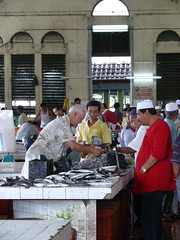
Old markets have become one of the attraction for independent travellers and self-guided holiday-makers. Old markets in the city are seen as a first place of cultural contact for foreign visitors therefore an very important asset a city must preserve and protect from negative impact of modernisation in order to be continuously benefited from tourism. These are some of the information taken from guide books (Lonely Planet and Rough Guide) as well as travel magazines.

P.S. This post is live with new examples to be added at any time. Please do bookmark so you'll be updated to this expending list.

Bazaar Baru Market (Kuala Lumpur)
This lively market sells clothes, toys, buckets, stationery, noodles, spices, fresh meat and live, flapping catfish, as well as a staggering array of weird and wonderful tropical fruit. Overweight cats loiter around the wet market looking for scraps, and locals struggle through the narrow aisles with huge bags of shopping. Just wondering round is a heady, sensory experience, particularly for the sense of smell. (Lonely Planet)

Pudu Market (Kuala Lumpur)
Pudu Market is KL's biggest wet and dry market. It's a frenetic place, full of squawking chickens, frantic shoppers and porters forcing their way through the crowds with outrageous loads.....Arrive early in the morning to experience the market at its most lively and pungent. You can recover the sensory overload at the attached hawker court. (Lonely Planet)

Queen Victoria Market (Melbourne)
Opened in the 1870s, Queen Victoria Market remains one of the best loved of Melbourne's institutions. Its collection of huge, decorative open-sided sheds and high-roofed halls is fronted along Victoria Street by restored shops, their original awnings held up with decorative iron posts. Although undeniably quaint and tourist-friendly, the market is a boisterous, down-to-earth affair where you can buy practically anything from new and secondhand clothes to fresh fish at bargain prices. Stallholders and shoppers seem just as diverse as the goods on offer: Vietnamese, Italian and Greek greengrocers pile their colourful produce high and vie for your attention, while the huge variety of deliciously smelly cheeses effortlessly draws customers to the old-fashioned deli hall. (Rough Guides)

The way we live

Excerpts and scanned pages taken from The Way We Live by Cliff, Stafford & Chabaneix, Gilles de. [2003]

THE MARKET-PLACE
The fresh food market is the first step in the distribution of foodstuffs from kitchen garden, from farm and plantation, from field and orchard, from river and sea. Leaving aside the supply chains to supermarket and processed food plant, the market appeals to that deep human wish to acquire raw food in as fresh a condition as possible. And nowhere is this more true than in the fish and seafood stalls the world over.

Most markets impress by their colours and the simplicity of their presentation. In fish markets, especially those on the quayside illuminated by the intense light off the sea, the brilliance of the hues and the boldness of pattern make for delicious visual preliminaries to the pleasures of cooking and consumption. Pinks and reds combine with silvers to gleam and glow with phosphorescence in the fresh rays of a coastal dawn - here, in Tangier. And all the colours of the ocean rainbow hang in a quayside fishmonger's in Valparaiso, Chile.

A market is a place of abundance and of richness of display: colours bright and fresh, whether arranged singly or in pyramids. Thank goodness, what is on sale varies from place to place, country to country, but we recognize the authentic market the world over by its evocation of 'plenty', by the display of tomatoes, peppers, courgettes and aubergines in any Mediterranean town, or by the towering arrangements of guavas, papayas, pineapples and breadfruit in the tropics. The breadfruit - proudly displayed by a Balinese chef (pic can be found from the book 'The Way We Live') - is native to the Pacific Islands. In 1793 it was introduced to Jamaica by Captain Bligh of Bounty fame in the belief that it could become the staple food of the slave population. The scheme was not a great success, but Jamaica does remain a major producer.

The imagery of the market-stall, whether a boat in Bangkok or a food counter in Burundi, is among the most potent in our appreciation of the good things of life and as close as many people get to the wider natural world. The imagery is rich in colour, texture, form and pattern, brought to life by the presence of people, often producers, in the processes of exchange. This is a world of buyers and sellers meeting with immediacy impossible in more rigidly formal environments (pic can be found from the book 'The Way We Live'). Sometimes the two parties come together in unplanned, spontaneous ways; this roadside market in Burundi developed as an almost impromptu happening (pic can be found from the book 'The Way We Live'). One man's meagre display is another's cornucopia; but however rich or spare the presentation, there is always the prospect - warm and reassuring - of acquisition and eventual consumption.

Whether a neighbourhood market in Paris, Rome or London or a village or country-town market in Morocco or Mauritius, the gathering together of people and produce is a real point of focus for a community, and any visitor. It is an opportunity for the exchange of views and gossip; and the feel-good fallout from the presence of so many good things is incalculable (pic can be found from the book 'The Way We Live'). Elizabeth David, surely the greatest English writer on food matters, found a unique joy in the sheer volume and variety on display in a good market: tomatoes, courgettes, peppers, melons, asparagus, strawberries, redcurrants, cherries, apricots, peaches, pears and plums. Her remarks were largely confined to descriptions of the markets of Provence and Italy, but her enthusiasm powerfully evoked the feelings aroused by food markets throughout the world.


The sights and smells of the old markets

Explorers, traders, writers, poets, historians, botanists, sailors from the past centuries to modern time travellers, backpackers, film makers, photographers, journalists, writers, artists have been recognising old markets as one of the memorable and beautiful sights encountered. From Rialto market of Venice to old market at Cusco, below are two of the excepts found from travellers' literature.

INDIAN MARKET
I STEPPED OFF THE BUS IN THE MORNING AT HAMPI Bazaar, a place so bewilderingly strange to Western eyes that I could hardly believe I was seeing it. There was a double row of broken columns, the equivalent of several blocks long. Though now roofless, you'd call it an arcade if you saw it in Italy or at a Californian mission. The columns were huge. They stood maybe as much as five or six feet apart, and, in places, two or three ancient steps still led up to a floor paved with granite slabs, straw, merchandise, and people. It was such a jumble that it took me a few minutes of taking a step and staring, taking another step and staring, to realize that these were people's homes and people's stores. The merchandise-sandals here and pots there, basins, soap, cups, mats, cosmetics, food, fabrics, saris, a thousand items-formed the walls between the columns. Often the merchandise also formed a barrier between the front and back of the stalls. There may have been two families to a stall. Maybe more. There were multitudes crowded between the huge broken columns, sitting about in the streets, walking up and down, staring at the occasional foreigner, no doubt hoping they would buy something; but mosdy the vast milling crowd was just living, friendly, curious, and welcoming.
-JAN HAAG, "'A VISION OF VIJAYANAGAR," Travelers' Tales India

A FRENCH MARKET
I HAVE NEVER FOUND A MORE PLEASANT WAY TO GO shopping than to spend two or three hours in a Provencal market. The color, the abundance, the noise, the sometimes eccentric stall-holders, the mingling of smells, the offer of a sliver of cheese here and a mouthful of toast and tapenade there-all these help to turn what began as an errand into a morning's entertainment. An addict could visit a different market every day for several weeks..
-PETER MAYLE, Encore Provence

Old Ceko Market (after)

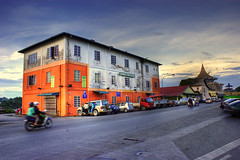
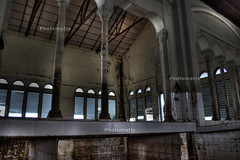
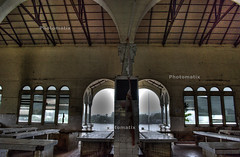
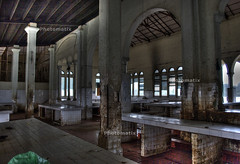
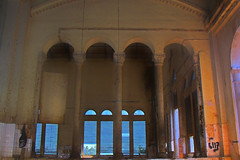
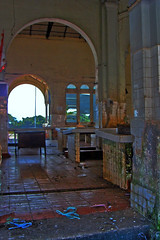
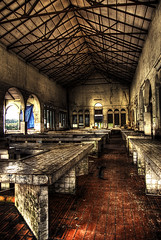
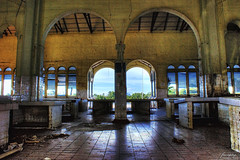
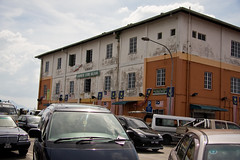
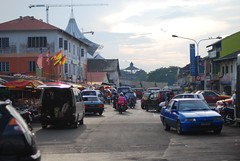
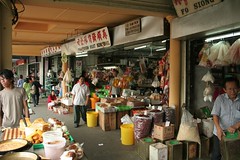
On 15 June 2008, Kuching Ceko market in the heart of the city was shut down for future developments. Hawkers were all relocated to a newly built facility - Stutong market on the outskirt of the city.

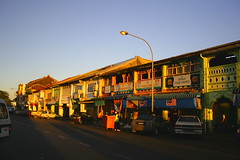
The demolition date is still unknown. There is rumours that the hotel-shopping centre development might be aborted and a new scheme might be to extend the waterfront promenade. Whatever development might occur there, the most important heritage of Kuching will be lost forever. Adjacent businesses that closely associated with the markets are considerably affected as well as the livelihood of locals from nearby villages.

See link Kuching Sanctuary Hotel and Mall Kuching development

The market is currently devoid of life like a ghost town. The online article titled 'The last day of Ceko Market' recorded the account of incident around the time before and after the closure of the market. Recommended Read !

See link Old Ceko Market (before)

Below are some of the photos found at Flickr:


kuching city
Originally uploaded by ammirul7277


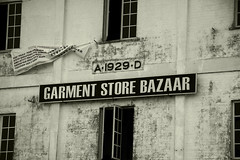
Garment Store Bazaar - 1929
Originally uploaded by framptop


Forceful notice
Originally uploaded by szejia


History
Originally uploaded by Michael Loke


Time Passing By
Originally uploaded by framptop


Kuching
Originally uploaded by Jason Ambarita


Old Kuching Wetmarket in HDR
Originally uploaded by sayap+dewa


Old Kuching Wetmarket in HDR
Originally uploaded by sayap+dewa


Old Kuching Wetmarket in HDR
Originally uploaded by sayap+dewa


Left behind all the memories
Originally uploaded by framptop


Nobody here
Originally uploaded by framptop


hdr-pasar ikan ceko/fish market(in memory)
Originally uploaded by eshump-moo-dane


It All Begin Here
Originally uploaded by framptop

Old Ceko Market (before)


Kuching waterfront from Sarawak River cruise
Originally uploaded by John Steedman


overlooking kuching ol wet market
Originally uploaded by uuuuuuU


Kuching Fish Market from Sarawak River cruise
Originally uploaded by John Steedman


Sarawak River, Kuching, Sarawak
Originally uploaded by John Steedman


DSCN0077
Originally uploaded by Hannah Blagnys


Kuching waterfront
Originally uploaded by spOt_ON


Old Market - Kuching
Originally uploaded by Michael Loke


kuching03
Originally uploaded by displace


kuching02
Originally uploaded by displace


DSC_9978
Originally uploaded by spOt_ON


Old Shop House
Originally uploaded by Nick_Jong


Kuching Street Scene (Lomo)
Originally uploaded by magnusvk


Kuching Market shops
Originally uploaded by worldtour11


kuching wetmarket
Originally uploaded by mishes


spicy!
Originally uploaded by mishes


Photo by Desmond Ong

Photo by Desmond Ong


Photo by Desmond Ong

Photo by Desmond Ong

Discarding the old, in the new supermarkets - Asia

The increase popularity of shopping malls in Asia does help to put its most important tenant - supermarket in winning position over traditional farmers markets. For Kuching it is a double blow as after the closure of Ceko market the city has no markets in the city centre (except the Satok sunday wet market 1km away) hence giving golden opportunities for supermarkets to extend their radius to dominate and continue threaten the remaining old shops at the old quarters of Chinatown and Indian street.

The new Plaza Merdeka to be built in the heart of the old quarters presumably will has a supermarket will take over the original retail pattern left from the Ceko Market nearby (about 150m away) and will pose significant threat to the remaining shop fronts foods and produces and other retail sectors on that area.

Will the people go to the shopping mall to get all they need under one roof ignoring other traditional retails around the area?

The following excerpt taken from article published by Food and Agriculture Organization of the United Nations:

The move to supermarkets in Asia is driven by a number of factors - including automobiles...
  • Income growth has increased ownership of refrigerators, which has spurred a shift from daily to weekly shopping, and of cars, which permit large volume shopping at distant locations
  • Changing consumer preferences led by women's entry into the workforce. "Working women" prefer one-stop, fast, convenient, and value-for-money shopping
  • Changing eating habits - with more women working outside the home and families travelling further to work, there is increasing demand for processed food
  • Development of infrastructure, e.g. highways and transport, has favoured the development of supermarket chains
  • Low retail margins and fierce competition has created a "buyer's market" in which consumers enjoy low-cost services and quality - and happily switch between retail outlets
  • Demographic, cultural, social changes, including a growing proportion of nuclear families and "one-person households" and growing use of credit cards.
  • Increased travel has exposed Asians to modern retailing, a wider range of products and the availability of fresh produce "out of season".
The following excerpt taken from Differences in Factors Attracting Consumers to Taiwan's Supermarkets and Traditional Wet MarketsJournal of Family and Economic Issues

Exit interviews were used to summarize factors attracting consumers to six supermarkets and three wet markets in a representative city. Using the history of the marketplace as the foundation for analysis, the strengths and weaknesses of the two retail formats are introduced and are compared to the consumer response data. Findings indicate that the decline of Taiwan's traditional markets will probably continue until all are replaced by new retail formats. Currently, the traditional market is in the weakest of all the retail positions since it supplies the needs of a shrinking population of older consumers with preferences and shopping behaviors unlike those of younger, nontraditional consumers. Supermarket expansion is slowing because new hypermarkets, convenience stores, and warehouse stores are competing to satisfy the needs of the younger, more mobile target population. Overall, store formats that provide lower prices, sales promotions, a good environment, good product quality, and good service have the greatest opportunity to build consumer loyalty and increase market share."

Related Posts:
1) Benefits of markets
2) The market that defines the city [Melbourne]
3) Slow Living & Old Market

Kuching Waterfront and the old markets

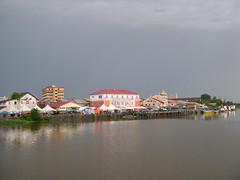
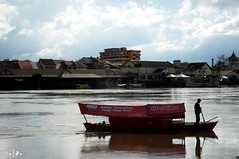
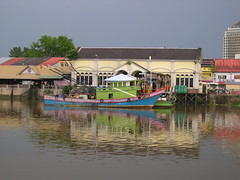
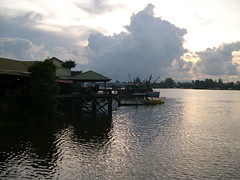
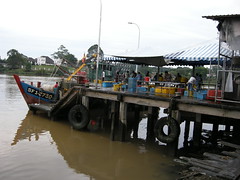
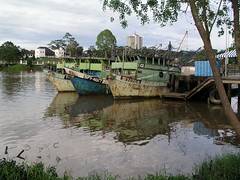
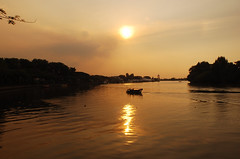
Photos show views from the same location - the eastern end of the Ceko old market overlooking
river edges of the Sarawak River. The southern edge (left of photo) is lined with market's buildings, dockyards. Fishing boats unload catches here at the loading docks (shown on second and third photo below). Sampan (small boat shown on the first photo) bring village residents from the northern side of the river to shop at the old markets everyday. Life like this has been going on for nearly a century.

"The wet markets are strategically sited. Boats bringing in produce can unload their goods at the back, while housewives on a shopping expedition approach the airy hall from the road." Quote from Sarawak sketchbook

Check this link to see the proposed plan to turn this stretch of waterfront into another modern leisure paradise which can be anywhere in the world. In other words, is this development necessary ? in the expense of one unique feature of the city? and also erasing city-working river relationship?

See post Kuching old Ceko Market


Kuching Waterfront 2
At Flickr by SamCotton

Photo by Desmond Ong

Photo by Desmond Ong

Sanctuary Hotel and Mall Kuching development


The building going to replace the current Ceko Market and Brooke Dockyard. The extent of adjacent old shops along Gambier Street and Jalan Pasar affected is unknown. I'd say the larger old precinct is threatened. Large part of Kuching's history will be erased.

See post Old Ceko Market (before)
See post Old Ceko Market (after)
See post Kuching waterfront and the old market
See external link Last day of Ceko Market


See link for more detail:
Kucing Berjanggut: Sanctuary Hotel and mall Kuching

Slow Living & old market

On a grey and bitterly cold early Saturday morning at Dunedin's weekly farmers' market we struggle with our bags of shopping as we make our way awkwardly through the crowded pathway. As we do we cannot but think of the new, shiny supermarket that has opened this week down the road from where we live. Its well- lit, warm interior beckons and it prompts us to wonder why we are here rather than there. As we do, we pause for a moment and take in the scene around us: the bustling stalls selling local fruit and vegetables, people tasting the organic pork sausages, the smell of coffee in the air, as well as much talk and laughter. We know we are putting up with the cold because we are committed to local food systems but we are also here because we enjoy the the sensory nature and the sociality of this space. There is a quality to this kind of space that distinguishes it from many other everyday experiences of space, including the new supermarket. Such an observation firstly reminds us that places are not just particular physical sites but they are also constituted as settings of interaction. Secondly, the material specificity of the farmers' market is appealing because it is different from, and challenges, conventional experiences of space in the global everyday: culture, traditionally thought of as bound to locality, is now derived from more abstract, deterritorialized contexts and relations. What implications does such a deterritorialized existence have for any conceptualization of the spaces of slow living? We will argue in this section that the concept of 'place' retains a significance in the global everyday and that deterritorialization paradoxically can contribute to a revitalization of the site of 'the local'. Modernity has initiated fundamental changes in the relationship between space and place.

Quote taken from "Deterritorialization, the Local and Place ", Slow Living.

Full Reference:
Parkins, Wendy & Craig, Geoffrey. [2006], Slow Living, UNSW Press

At KL's wet market


1. _M220119bw copy.jpg, 2. Wet wet wet market, 3. He's too shy to look at me, 4. _M108552bw copy.jpg, 5. Petai, 6. In the wet Market (Kuala Lumpur)

Bazaar Baru Market (Kuala Lumpur)
This lively market sells clothes, toys, buckets, stationery, noodles, spices, fresh meat and live, flapping catfish, as well as a staggering array of weird and wonderful tropical fruit. Overweight cats loiter around the wet market looking for scraps, and locals struggle through the narrow aisles with huge bags of shopping. Just wondering round is a heady, sensory experience, particularly for the sense of smell. (Lonely Planet)

Pudu Market (Kuala Lumpur)
Pudu Market is KL's biggest wet and dry market. It's a frenetic place, full of squawking chickens, frantic shoppers and porters forcing their way through the crowds with outrageous loads.....Arrive early in the morning to experience the market at its most lively and pungent. You can recover the sensory overload at the attached hawker court. (Lonely Planet)

At the Italian Markets
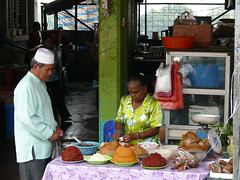


1. Fruit Vendor, 2. Bologna Street Markets, 3. Spending last penny, 4. Madama di Palazzo, 5. sguardi incrociati, 6. ripe hardiness06


"To Italians, a city without a fresh food market at its heart us a dead city. Their markets are thriving subcultures that provide an insight into the psyche of the city." Terry Durack, Travel + Leisure Magazine

"In an era of supermarket aisles, refrigerated cabinets and processed everything, this is a rare opportunity for the city to meet the country face-to-face." Travel + Leisure Magazine

"You can tell a lot about an Italian city by its market. No two are the same." Carla Coulson
 

blogger templates |