Showing posts with label old quarter. Show all posts

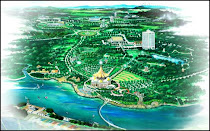
City Precincts


[1] Kuching mosque - Masjid Negeri [Photo 1]
[2] Historic Brooke dockyard [Photo 1] [Photo 2] [Photo 3]
[3] Hawker food centres
[4] Old Ceko markets (closed June 2008 for future development. Heritage at risk)
[5] Indian Street old quarter [Photo 1]
[6] Old Courthouse (1874)
[7] Plaza Merdaka shopping mall development [Website] (to replace heritage items - One row of old shophouses, hundred years old feature tree planting* and 1950s architecture*) *require further information
[8] Padang Merdeka
[9] Chinatown old quarter [Photo 1] [Photo 2]
[10] Kuching Waterfront (built on 1989, former shipyards site)
[11] Sarawak oldest Chinese temple Tua Pek Kong (built 1876)
[12] Kuching's central business district [Photo 1]
[13] Sarawak River [Photo 1]
[14] Villages
[15] Fort Margherita (1879) [Photo 1]
[16] Existing soft edge (threaten by future development)
[17] State Assembly Building (under construction)
[18] Astana (Governor's residence)
[19] Villages
[20] Existing soft edge


See related post- Kuching on Google Map

Kuching at a glance


Kuching Waterfront, Sunset
Originally uploaded by sayap+dewa


Kuching Waterfront
Originally uploaded by MarkLeo


Fort Margherita
Originally uploaded by Journey of A Thousand Miles


Astana
Originally uploaded by Ahock


D2H6685_20060208_1759_33
Originally uploaded by Ahock


Masjid Bahagian Kuching
Originally uploaded by bingregory


Part of Kuching - The triangle
Originally uploaded by framptop


Kuching Post Office
Originally uploaded by spOt_ON


part ii , colonial kuching
Originally uploaded by ★ mewot ★


Sarawak Textile Museum II
Originally uploaded by Tok Wae


Kuching - The Cat City
Originally uploaded by onggon ~ im on holiday


Museum Kuching
Originally uploaded by gLaSS 'n' MeTaL


Kuching
Originally uploaded by Yokels


India Street
Originally uploaded by MarkLeo

Case Study : Sydney's old Inner City we preserved

"For the new residents of Sydney's million-dollar slums, the close living is one of the attractions. ''I like to believe we're the only street in Sydney with a real sense of community," says Soo Haywood, a Little Comber resident of two years."

A quote from article "Be it ever so humble" published in Sydney Morning Herald on May 11, 2002.

Sydney example should set a precedent for many other cities that if the city authority and developers treat old quarters as city's problem and want to demolish to make way for modern development, they will run into a huge mistake by erasing city's history and character.

Sydney(1), now a truly global city has these old quarters that not only have maintained much of their character also have become as city's cultural precinct, nourishing dining and high-street retail scenes as well as art communities. More prominently these are now the most sought after place to live.

The process which is called 'gentrification' isn't perfect. It has resulted increase in land value; in some ways also alters the character and slowly pushes the poorer residents out the area.

Read previous posted entry : "Case Study - Sydney's Inner city from the slum to highly valued precincts" more detailed explanation of how Sydney' Inner City fell into slum during the last century.

Footnote:
(1) Sydney for only about two hundreds years old history is considered a young city.

Case Study - Sydney's Inner city from the slum to highly valued precincts

Before you read the extract below, we all know that a large part of Sydney old quarters (known as Inner-city) are still intact, mostly survive from demolition during 1970s. Now these old houses have become the highest value properties in the country. Not only they are highly desired house to live in it also bring ripple effect to the immediate streetscape and urban areas to become vibrant cultural precincts.

Extract from book "Planning Sydney's Future". It outlined how in the past old houses were perceived as problem to the society. Now condition changed so people shouldn't see it as problem but our cultural heritage we should preserve. This also proved that we can't solve social problems with bulldozers which is happening in cities like Shanghai, Beijing...

"At the end of the Second World War Australia faced the worst housing crisis in its history. A survey conducted by the Commonwealth government in 1944 showed a national housing shortage of almost 200 000 dwellings, with Sydney needing about 35 000 of these. This was before replacing the 19 000 inner-city 'slum' dwelling that were earmarked for demolition. The 1947 census showed that of Sydney's population of almost one and a half million, about three-quarters lived in private houses occupied by only one family, another 15 per cent lived in flats. while the remaining ten per cent shared private houses or lived in boarding houses. On average, four people lived in single-family private houses, while six lived in share houses. But in the poorer parts of the inner city it was not uncommon for three or four families to be sharing overcrowded and often unsanitary terrace houses.

With demobilisation came demands for postwar reconstruction. Blueprints for better houses and better cities were an important part of armed services propaganda. In 1945 the Sydney architect Walter Bunning wrote an influential book about the past, present and future of Australian housing which he called 'Homes in the Sun'. In his foreword H. C. Coombs, director~general of postwar reconstruction, wrote that the book 'will be of direct and personal interest to every Australian man and woman who will in the coming years be setting up their own homes'. Bunning wanted new homes to be built 'to admit sunshine and fresh air, to have healthy surroundings, peace and quiet and to suit our climate and traditions'.

Like the Cumberland planners. Bunning painted a bleak picture of Sydney's slums. which he characterised as having narrow, ugly streets and pocket-handkerchief allotments, forcing children to play in 'lanes and alleys' and their parents 'to sit on their doorsteps' (1). Such attitudes encouraged property interests to welcome the expansion of the City core into suburbs like Pyrmont, Chippendale and Woolloomooloo because substandard housing would be replaced by commerce and industry. In other inner suburbs, like Paddington, Redfern, Surry Hills, Alexandria, Waterloo, Erskineville, Newtown, Glebe and Balmain it was assumed that demolition and rebuilding would be required for most of the houses and that the New South Wales Housing Commission. created in 1941, would do the bulk of the work."

'Planning Sydney's Future' by Peter Spearritt & Christina Demarco. Published 1988 by Allen & Unwin Sydney

Article "Be it ever so humble", published May 11, 2002 at
Sydney Morning Herald explains the transformation Sydney's Inner city had experience.
Quote : "Sydney's smart - and expensive - Victorian houses were once hosts to squalor and plague", writes Anne Davies.

(1) Scene like this is common in the large part of Europe nowadays. It is in fact the healthiest, and more environmental friendly way of living. The low, tight and intimate neighbourhoods also create strong sense of community.

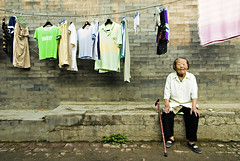
Diminishing way of life #1 - Beijing

It is not hard to find a beautiful scene like this in Italy where locals still live in traditional way (even in the cities) and this way of life will go on pretty much forever.

In China, its own unique cultural heritage and the way of life will be diminished in the name of modernisation.

Click photo to view original photo and narration at Flickr.
 

blogger templates |